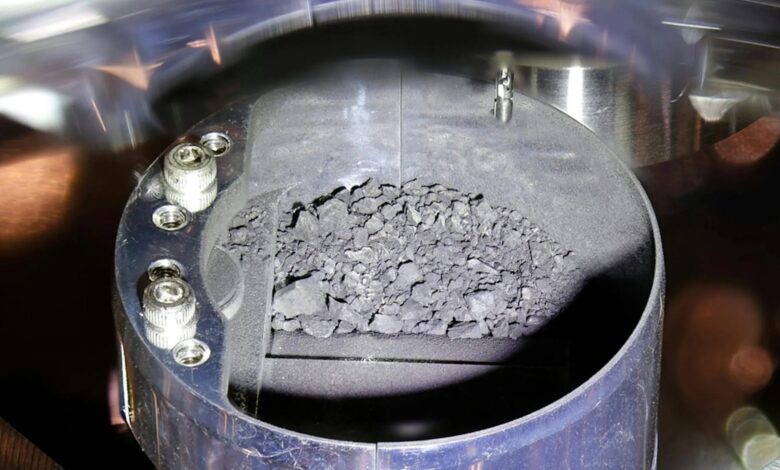
Ryugu sample in its return capsule. Photo Credit: JAXA
EnvironmentTechnology The WorldAncient Asteroid Reveals New Clues to Life
Scientists have discovered all five essential molecular building blocks of DNA and RNA in pristine samples from a 4.5-billion-year-old asteroid, strengthening evidence that the ingredients for life existed in space long before life emerged on Earth.
The discovery supports the possibility that asteroids helped deliver the chemical ingredients necessary for life to our planet. The findings suggest that these molecules were already widespread throughout the early Solar System, offering new insights into the origins of life on Earth.
Japan’s Hayabusa2 mission returned 5.4 grams of material from asteroid Ryugu in 2020. Scientists identified all five nucleobases — adenine, guanine, cytosine, thymine and uracil — in two carefully preserved samples, with the molecules present in roughly similar amounts. Previously, scientists had detected only uracil in Ryugu material. The findings complement discoveries from NASA’s Bennu asteroid samples in 2025 and earlier analyses of the Murchison and Orgueil meteorites. While the relative abundance of these molecules differs between asteroids, possibly due to variations in ammonia levels, their presence across multiple ancient space rocks suggests that the chemical foundations of genetic material were widespread billions of years ago. The discovery does not establish that life originated in space, but strengthens the possibility that asteroids supplied essential ingredients to the early Earth.