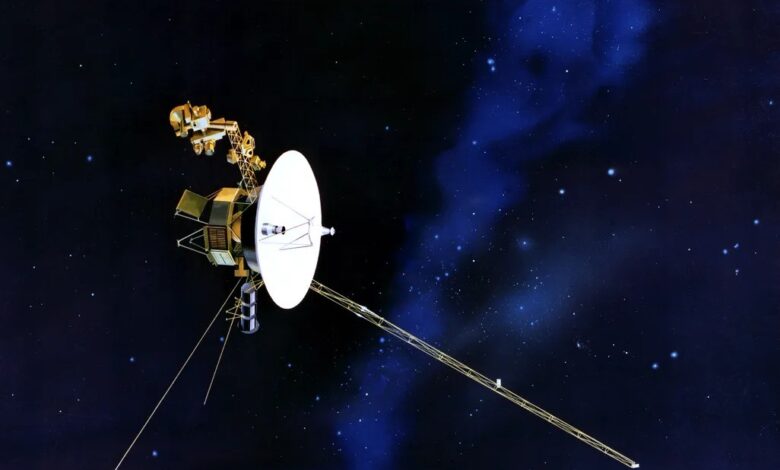
On November 18, Voyager 1 will reach 16.094 billion miles from Earth, the distance light travels in 24 hours. Image Credit: NASA / JPL
Technology USAVoyager 1 Approaches Historic Space Milestone
Nearly 50 years after its launch, NASA’s Voyager 1 spacecraft will reach a record distance of one light-day from Earth on 18 November 2026, marking another milestone in humanity’s exploration of interstellar space.
“I just never imagined [the mission] would last that long,” said Linda Spilker, planetary scientist at NASA’s Jet Propulsion Laboratory and Voyager project scientist, who joined the mission shortly before its launch in 1977.
Voyager 1, the farthest human-made object from Earth, will reach a distance of approximately 25.9 billion kilometres, meaning radio signals travelling at the speed of light will take 24 hours to reach the spacecraft and another 24 hours for a response to return. Launched alongside its twin Voyager 2 in 1977 to explore the outer planets, Voyager 1 entered interstellar space in 2012, followed by Voyager 2 in 2018. Both spacecraft have continued transmitting valuable scientific data far beyond their original missions. Engineers have extended their operational lives through innovative energy-saving measures, including switching off non-essential instruments as their nuclear power supplies gradually decline. Voyager 1 still operates two scientific instruments that study magnetic fields and plasma waves in interstellar space. The approaching milestone highlights nearly five decades of engineering ingenuity and scientific discovery, with the spacecraft continuing its journey into the space between the stars.