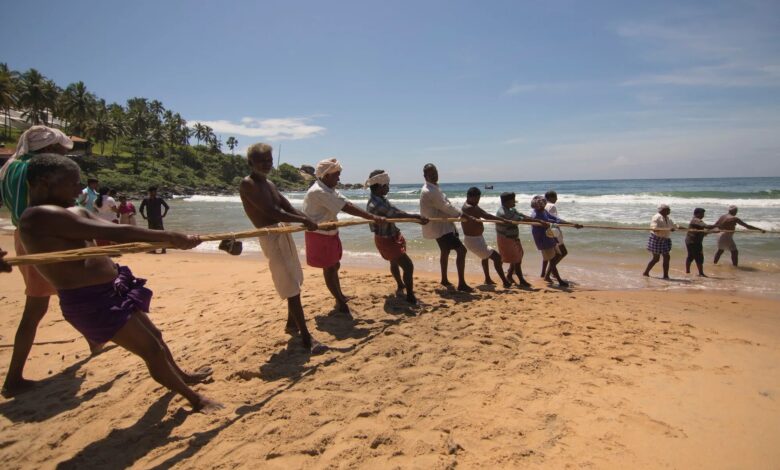
Trivandrum, Kerala, India: Fishermen pull their boat ashore, a task that relies on coordinated community effort. Kerala’s experience reflects extensive community participation, showing that although modest means present daunting challenges, they need not constrain efforts to confront extreme poverty when priorities are in place. Photo Credit: Shutterstock/RIJU RAY
Society IndiaExtreme Poverty Eradicated, Thanks to Locals
India’s Kerala state, home to 34 million people, has virtually eliminated extreme poverty by combining strong public services, targeted safety nets, and community-driven monitoring to reach even the most marginalised households.
“When social priorities are bold and local participation is serious, even modest economies can end deprivation,” said Chief Minister Pinarayi Vijayan.
Kerala’s multidimensional poverty index fell to just 0.55% of its population, meaning roughly 187,000 people remained extremely poor in 2021 compared with nearly 60% in the 1970s. The milestone was achieved through long-term investment in health, education, and fair distribution, supported by the Athidaridrya Nirmarjana project, a statewide initiative to identify families still living in severe deprivation and link them to essential services, and by Kudumbashree. This women-led network mobilises millions of households for local development. Together, they built a rapid-response system that ensures no one is left behind.