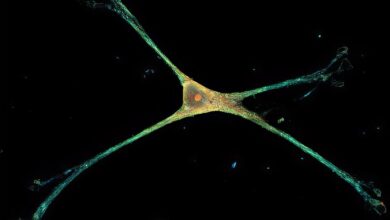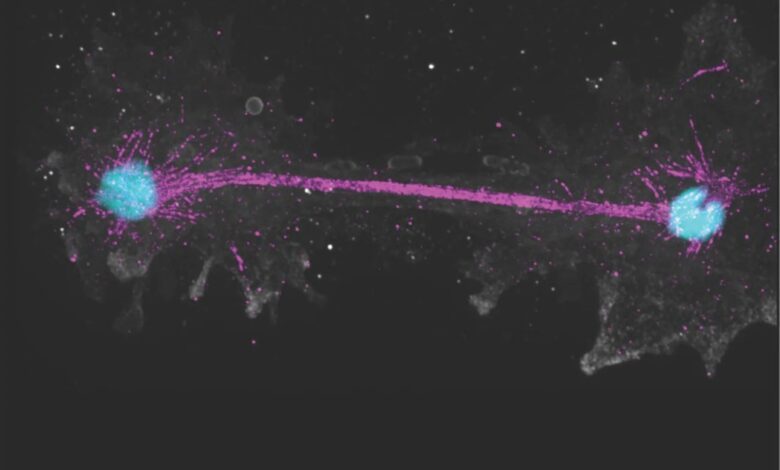
Introducing Incendiamoeba cascadensis, which translates to "fire amoeba of the Cascade mountain range." Image Credit: Felix Mikus
Environment United StatesNewly Discovered ‘Fire Amoeba’ Breaks Heat Tolerance Record
Scientists have discovered a heat-resistant amoeba in the United States that can reproduce at 63°C, setting a new temperature record for complex cellular life.
“It wasn’t so much the incremental amount that this record was broken by, as much as the proof that it was possible,” says Angela Oliverio, microbiologist at Syracuse University.
Discovered in a geothermal stream in Lassen Volcanic National Park, the single-celled organism, Incendiamoeba cascadensis, can reproduce at temperatures about 3°C higher than the previously known limit for complex-celled organisms. It can also remain mobile at 64°C and survive temperatures reaching 70°C by entering a protective state. Unlike simpler microorganisms such as bacteria and archaea, which can thrive above 100°C, amoebas possess complex cellular structures, including a nucleus. Genetic analysis revealed adaptations that help stabilise the organism’s proteins and cell membranes under extreme heat. These mechanisms could eventually inform the development of heat-resistant crops, more temperature-stable medicines and the search for life in extreme environments beyond Earth.