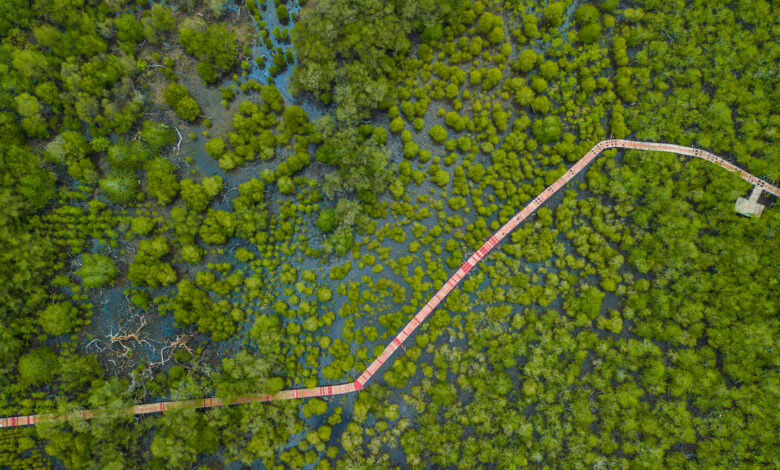
Magrove forest with wooden bridge, Thailand. Photo Credit: Suphanat Wongsanuphat/Getty Images
Environment The WorldMangrove Forests Make Remarkable Recovery
Mangrove forests worldwide have shifted from net loss to net growth since around 2010, demonstrating the remarkable ability of these vital coastal ecosystems to recover naturally.
“Our findings reveal the underestimated resilience of a highly threatened ecosystem,” says Zhen Zhang and an international team of researchers who analysed four decades of global mangrove forest changes.
Using satellite imagery from 1984 to 2023, scientists found that global mangrove coverage declined by just 0.5% over four decades, within the study’s margin of uncertainty. While mangrove losses dominated in earlier decades, natural regeneration and expansion into newly formed coastal habitats have increasingly offset deforestation and erosion. Both permanent forest loss and canopy degradation have slowed substantially since the 1980s, while surviving mangroves have continued to grow denser through natural canopy accumulation. Much of the recent recovery has occurred as mangroves colonised new tidal flats, alongside regrowth in previously damaged areas. These findings demonstrate the resilience of coastal ecosystems and highlight how protecting existing forests and allowing natural regeneration can strengthen biodiversity, coastal protection and long-term carbon storage.