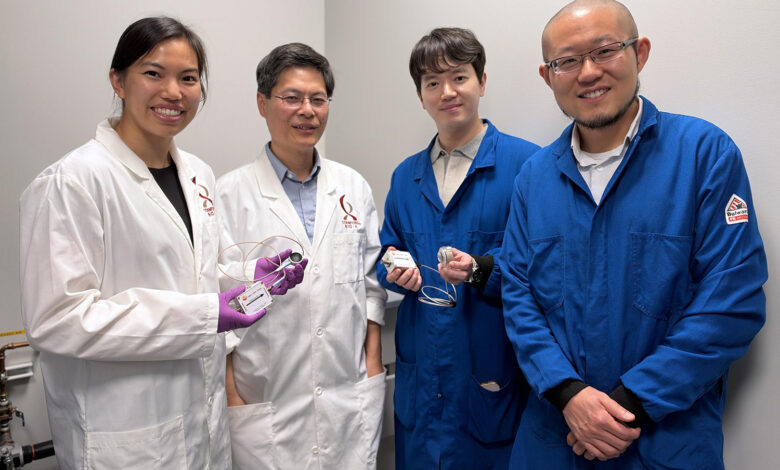
Marigold Gil Malinao (left), a materials science and engineering PhD student, and Daesun Song (second from right), a postdoctoral scholar in neurobiology, hold up ultrasound devices they used to trigger light-emitting nanoparticles and CRISPR gene editing in mice. Malinao performed the nanoparticle injection and ultrasound simulation and was second author on the new paper. Song was the paper’s first author. They are pictured with senior authors Michael Lin (second from left) and Guosong Hong (right). Photo Credit: Courtesy Guosong Hong
HealthTechnology USAGene Editing Takes a Precise New Turn
Scientists in the United States have developed a non-invasive technique that lets them edit genes in specific areas deep inside the brain, opening possibilities for more targeted treatments of neurological conditions.
“I’m excited by the possibility that researchers – and hopefully future clinicians – can control gene activity at different locations in vivo,” says Michael Lin, Professor of Neurobiology and Bioengineering at Stanford University.
The technology combines three elements: focused ultrasound, light-emitting nanoparticles and a light-sensitive CRISPR gene editor called Cas12f. Ultrasound waves penetrate deep into tissue, triggering nanoparticles to emit light that activates gene editing only in the targeted area. In experiments with mice, scientists successfully edited genes on one side of the brain while leaving the other side unaffected, demonstrating precise spatial control without surgery or implanted devices. The advance could eventually help treat conditions such as neuropathic pain by switching off pain-related genes only in affected regions, potentially avoiding the widespread numbness associated with less targeted approaches. The team is also developing a wearable ultrasound device and exploring ways to temporarily regulate gene activity without permanently changing DNA. Although still at the experimental stage, the technology offers a promising route towards more precise and less invasive therapies.