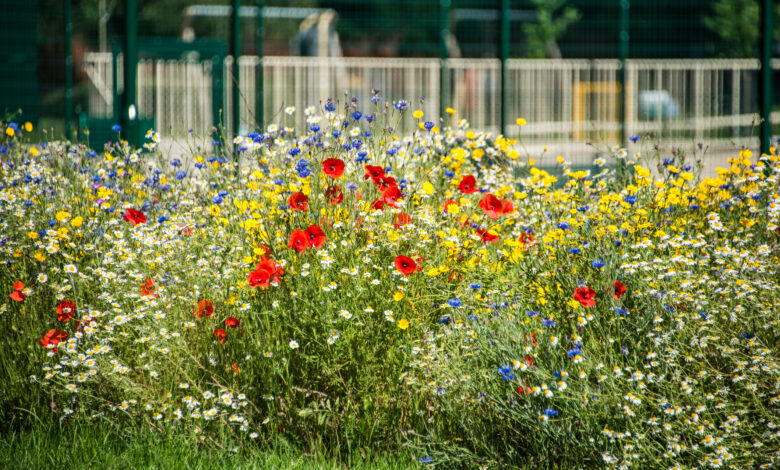
A dense wildflower meadow bursts with red poppies, ox-eye daisies and blue cornflowers alongside a school playing field fence in North London. Yellow composite flowers scattered throughout the mix add further colour, part of a wider effort to introduce pollinator-friendly planting to municipal green spaces. Photo Credit: Sergio Amiti/Getty Images
Environment United KingdomWildflower Verges Double as Butterfly Numbers Rise
Roadside wildflower habitats in London, UK, have doubled in size over two years, creating more space for wildlife and helping butterfly populations recover.
“The expansion of wildflower verges across London shows how simple changes can have a big impact, helping nature thrive,” says Mete Coban, Deputy Mayor for Environment and Energy.
Since 2024, wildflower verges managed by Transport for London have expanded from 260,000 to 520,000 square metres, equivalent to around 72 football pitches. By reducing mowing from up to eight times a year to twice annually, these areas provide more food and shelter for bees, butterflies, birds and small mammals. In 2025, surveys across 34 sites recorded around 720 butterflies from 22 species, with average sightings up more than 50% from the previous year. The flourishing green corridors also help store carbon, reduce mowing emissions, and strengthen urban biodiversity.